What is Neurocad™?
Neurocad™ is the intent compiler for physical engineering. It turns static engineering artifacts, including datasheets, PDFs, drawings, reference designs, and existing CAD outputs, into native, parametric, design-ready assets that work directly in the tools your teams already use.
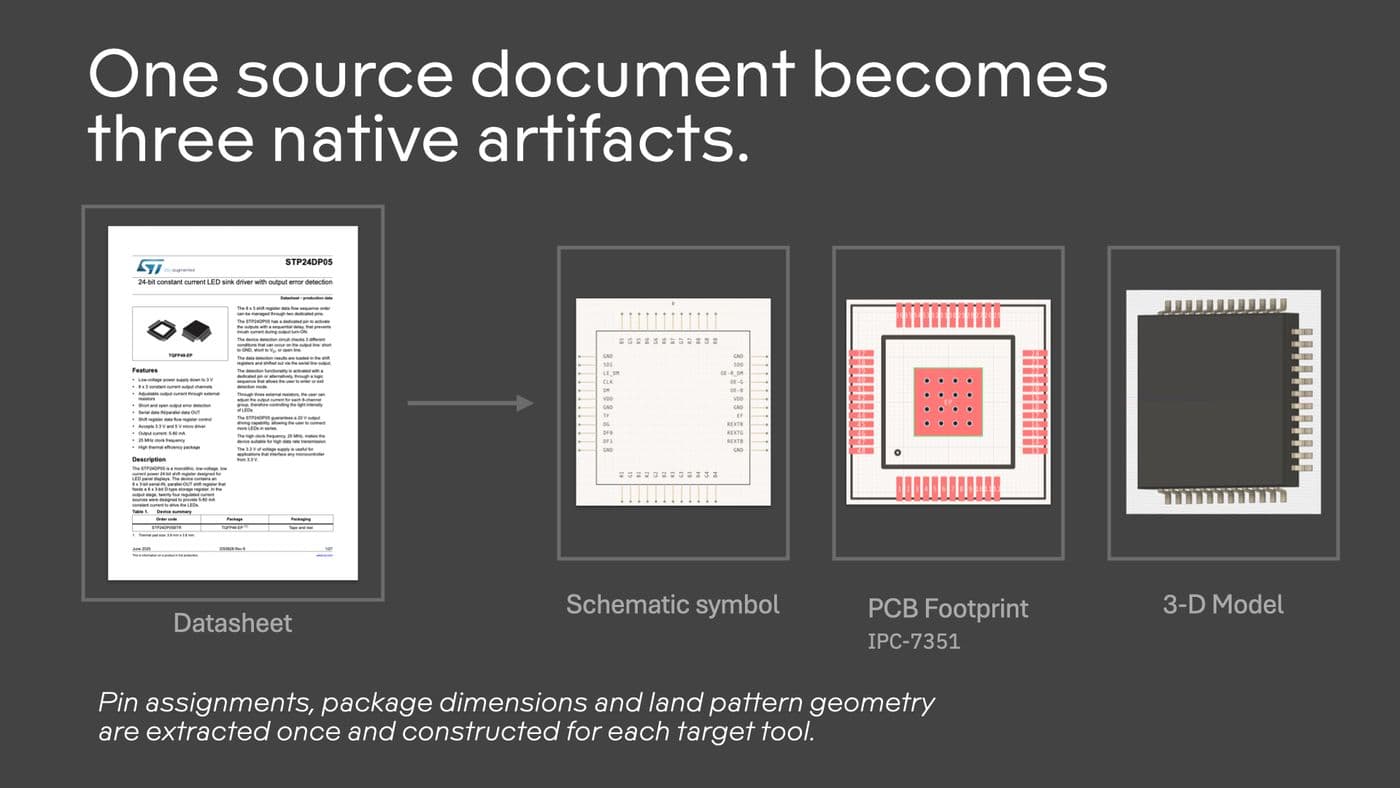
Neurocad does not replace CAD. It eliminates the manual interpretation, reconstruction, and re-entry required to move engineering information into CAD, preserving design intent while accelerating execution.
The AI describes it. Neurocad makes it real.
AI can read datasheets, interpret drawings, and generate design suggestions in seconds. What it can't do is deliver those results as something your CAD or EDA tool will actually accept. That last mile still falls entirely on the engineer. Manually translating intent from a PDF into Altium. Re-entering parameters from a reference design into SolidWorks. Reconciling what an AI suggested with what your tool chain requires. The content exists. The intent is clear. But closing that gap, paying the reconciliation tax, boundary by boundary, is still your problem.
Neurocad™ changes that. It reads what you already have — datasheets, reference designs, images, drawings — extracts the engineering intent inside them, and through native synthesis materializes that intent as parametric, design-ready assets directly in the tools your team already uses. No intermediate format. No re-entry. The output behaves correctly inside your tool from first use.
As AI accelerates how quickly intent can be defined, Neurocad™ ensures it doesn't stall at the tool boundary. The AI describes. The kernel executes.
The result is engineering assets that are portable, automatable, and interoperable across every engineering ecosystem simultaneously — not locked inside any single tool, vendor, or platform.
Neurocad™ is not a CAD replacement. Your tools stay exactly where they are. Neurocad™ is what makes them the last step, not the first obstacle.
How Neurocad™ changes the way engineers work
Engineering teams spend more time reconstructing design intent across tool boundaries than doing forward design.
Neurocad™ eliminates the work that happens before the work
Before any design decision gets made, an engineer has to build the components. Each one means opening a datasheet, extracting pin assignments by hand, constructing a schematic symbol, measuring pad geometry, building a footprint, generating or sourcing a 3D model, and verifying the whole assembly against IPC-7351. That is 30 to 90 minutes per component. A complex NPI program carries 30 to 50 of them. This is not an edge case. It is a normal Tuesday.
Neurocad™ does this from the source documentation. The datasheet arrives. Ratiometric inference resolves what is ambiguous or incomplete before any geometry is committed. Native, parametric, DRC-valid assets go directly into the target tool. What used to occupy the first days of a new program happens in minutes. The library backlog between component selection and design start disappears.
Neurocad™ removes the judgment call from component creation
Every component a library engineer builds from a datasheet currently contains an inference. A dimension that was ambiguous. A tolerance that was implicit. A pad geometry that had to be derived from a note rather than read from a clean specification. That inference gets committed to the library and inherited by every design downstream. It is the origin of the symbol and footprint mismatch errors that appear on project load.
Neurocad’s ratiometric inference engine resolves the ambiguity before geometry is generated. The intent review step surfaces every extracted parameter and inferred dimension for engineer confirmation before generation begins. Review before commit is the step that makes the output trustworthy, and it is the step no other tool in this workflow has.
Neurocad™ ends the ECAD to MCAD rebuild cycle
Every time a board changes, the mechanical engineer imports a new STEP file and the parametric relationships they spent two days configuring are gone. Mates fail. Keep-out zones are wrong. The constraints that governed the enclosure have to be rebuilt from scratch. Across a program with six board revisions and tight packaging constraints, this is weeks of engineering time spent on reconstruction rather than design.
Neurocad™ performs native synthesis at the ECAD-to-MCAD boundary. The output is a parametric model with a complete feature tree built directly inside SolidWorks or Fusion 360 — not a translated STEP file, but a model that belongs in the tool. When the board updates, the assembly survives it. The constraints hold. The rebuild cycle disappears.
Neurocad™ works inside the tools and workflows engineers already use
Neurocad™ works through Slack, GitHub, and native integrations with Altium, KiCad, SolidWorks, and OrCAD. A Slack @mention triggers a recipe. A GitHub commit triggers a pipeline. Design-ready assets appear in the tool the engineer is already in. No new application to open. No new environment to learn.
Neurocad™ returns engineering time to engineering
Neurocad™ does not make engineers faster at the work they should be doing. It eliminates the work they should never have been doing in the first place. What those hours become is the point: designs that get explored, programs that run on schedule, senior engineers who spend Monday on forward design instead of library maintenance.
It isn’t unsolvable. It was just unsolved.
Run a datasheet through the intent review step. See the reasoning surface. See the asset land in your tool, parametric and clean, with nothing to reconstruct on the other side. Try it yourself at neurocad.com.
About Neurocad
Neurocad™ is built by engineers who spent their careers inside the workflows this platform is designed to fix. Previously at Accel EDA, Altium, Autodesk, Meta, Microsoft, HP, and Siemens building tools used by millions of designers, engineers, and consumers worldwide.
Neurocad™ is the intent compiler for physical engineering — turning unstructured documentation into native, parametric, DRC-valid CAD output across Altium, SolidWorks, KiCad, and adjacent engineering environments.
Last updated May 20, 2026