Your datasheet is a sales tool. Is it closing?
A customer finds an element in your datasheet with no stated purpose. Your symbol, footprint, and evaluation board each treat it differently. The customer posts the question in your forum, and an applications engineer confirms the element is correct and explains its function. The answer took one reply. The customer's layout sat idle for hours, if not days.
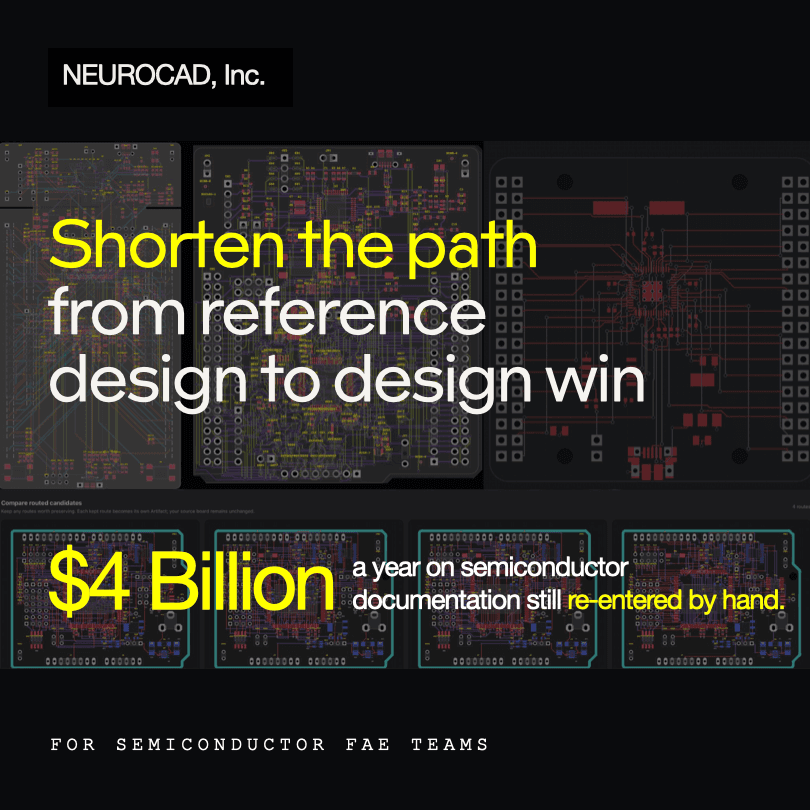
Threads like this run through every supplier's community forum, and they trace to one cause. Each file describing a part is authored and maintained separately, so the files drift apart. Neurocad removes that drift at the source by generating every file from one model of the part.
Where artifact drift comes from
A single part ships with a datasheet, schematic symbol, PCB footprint, 3D model, evaluation board, reference design, and getting-started guide. Product, applications, and content teams produce them at different times, often in different CAD tools, sometimes through third-party library vendors. Each file is a separate derivation of the datasheet. Corrections land in one and miss the rest.
The elements most prone to drift are the ones datasheets explain least: reserved and no-connect pins, mechanical and thermal features, keep-out areas, package variants, and pin names that change between documents.
What drift costs the supplier
Your customers' options when files conflict are familiar: guess and risk a respin, wait on support, redraw the part, or move to a competitor whose files are consistent. Neurocad estimates a redraw at 30 to 90 minutes per part, a wait for vendor CAD assets at one to five days, and an average prototype respin at about $9,000. The supplier absorbs three costs of its own.
- Support load. Applications and field engineers spend hours on questions the documents should answer. Those hours come out of new design-ins.
- Lost evaluations. Part choices settle before layout begins. A conflict found during evaluation arrives at the decision point, and an abandoned evaluation leaves no trace in your analytics.
- Share of wallet. A bill of materials holds about 50 parts. A second part in the same design doubles your revenue from it. A processor win should pull your power management parts in behind it, and reference designs exist to make that happen. A customer whose first experience with your content was reconciliation is a weaker prospect for the second part.
Why the fix rarely comes from inside
Top-tier suppliers fund large content operations: field teams, reference design groups, design platforms, distributor programs, and third-party library services. Neurocad estimates one such supplier's annual spending in the hundreds of millions of dollars. Files still drift at that scale, because the work remains manual and spread across teams. Mid-tier suppliers publish PDFs.
Closing the gap internally takes browser viewers for schematic, PCB, and 3D; importers and exporters for every major ECAD and MCAD tool; IPC and JEDEC geometry and material libraries; and developers fluent in those tools' internals. CAD vendors change their formats with each release, so the staffing is permanent.
How Neurocad removes drift at the source
Neurocad generates a supplier's CAD content from one model of each part. Every downloadable file comes from that model, so the files agree with each other and with the datasheet.
One model per part
Neurocad reads the datasheet and builds a part model holding the signal-to-package mapping, dimensions, and constraints. The symbol, footprint, and 3D model are generated from it and exported natively to Altium, OrCAD, Allegro, and KiCad, and to SolidWorks, Fusion, and Inventor. A revision to the model regenerates every format.
Ambiguity resolved before release
Neurocad presents its interpretation of the source for review before it generates files. Your engineers resolve unstated elements at that step, once. The answer that would have gone into a forum reply goes into the model, and every customer receives it with the download.
Footprints customers can verify
Footprints follow IPC-7351 at all three density levels, so the customer's manufacturer can match its assembly process. Neurocad exposes the parameters and measurements behind each part, and a customer's librarian audits the numbers directly.
Reference designs in the customer's tool
Neurocad converts Altium SmartPDF reference designs into editable schematics in the customer's CAD tool. The reference design is the supplier's primary vehicle for the second part, and it now arrives in a form the customer can build on.
Delivered on your site, at your scale
Generated parts embed on your own product pages. One correction reaches every engineer who downloads afterward. A field application engineer meets about 12 customers a week and an applications engineer about 30; each of those conversations starts with files that open cleanly. For suppliers without a content team, Neurocad offers datasheet-to-part generation as a service, with no added headcount.
The cost comparison
Every supplier already pays for drift: library services, format translation, support hours, and evaluations lost before layout. The comparison for a product or digital leader is the sum of those costs against one source that produces every format, plus the second-part revenue that consistent content puts within reach.
Your competitors publish to the same engineers. The supplier whose files arrive complete and consistent places the first part in the design and holds the best position for the second.
Frequently asked questions
Why do datasheets and CAD files disagree?
The datasheet, symbol, footprint, 3D model, and evaluation board are usually produced by separate teams and maintained on separate schedules. A clarification added to one rarely propagates to the others.
What is artifact drift?
Artifact drift is the gradual divergence of documents derived from one part, such as its symbol, footprint, and reference design, as each is edited independently. It is most common around elements whose purpose the datasheet leaves unstated.
How can a semiconductor company provide CAD models without a content team?
Neurocad generates symbols, IPC-7351 footprints, and 3D models directly from datasheets, in native formats for the major ECAD and MCAD tools, and offers that generation as a service. The supplier provides datasheets and publishes the results on its own site.
How do reference designs increase share of wallet?
A reference design pairs a supplier's primary part with its supporting parts, such as power management, in a tested circuit. When the customer can open it in their own CAD tool, those supporting parts move into the design with it.
What is the reconciliation tax?
The reconciliation tax is the engineering time spent rebuilding design intent by hand each time it crosses a document or tool boundary. Zero re-entry is the practice of carrying that intent forward so no one retypes it.